Saturday, August 19, 2006

Say "No" to Mealtime Battles with Your Child

Are you stressed out with your child's eating antics? Every parent has this ideal that their young child will learn to obediently sit down at the table during mealtimes and independently feed themselves. They will not complain about what you put on their plate, finish their food (even the vegetables) without fidgeting and they'll do it without any mess.


If your child falls short of this ideal, don't fret. It is only normal for a child to eat like a child. It takes time (even years) and lots of practice and reminders before they learn how to eat like an adult. So, how does a child eat? It is very likely they will display one or more of the following:

1. Picky with their food or refusal to eat.

2. Insist on being fed.

3. Keep the food in the mouth for long periods of time before swallowing. "Are you done yet?" is your mantra.

4. Squirm when sitting at the table. Cannot sit long or scream when put in the chair.

5. Prefer to walk around and play while eating. They end up taking about an hour or more to finish their meal because of the distractions. You chase them around trying to get a spoonful in their mouth and constantly remind them to "eat their food."

6. Makes a mess. There is more food on the ground and table than what goes in their mouth.

Fighting these antics and losing the battle most of the time is what makes an irritated, angry, disgruntled, exhausted but worried parent. What to do? It's time to change the battle strategies. The first thing you have to give up is the idea that your child will starve or be malnourished if they don't eat exactly what you give them and finish how much you give them. They won't! If you can do this, half your battle is won.

Here are a few things to understand in your attempt to improve mealtimes:

1. After a child's first year, their growth rate slows down. And with that, their appetite drops as well. Therefore they may not eat as much as you expect. Trust that they know when they are full. Do not harass them to clean their plate or you will teach them to associate eating with hunger instead of eating to please you.

2. Refusing to eat, picking at food or eating the same kind of food repeatedly is usually just a phase they go through. Even adults have certain dislikes for certain foods. Provide a variety of foods but give them the freedom to like or dislike. Respect their developing individuality. You could also take up the challenge of learning to prepare certain kinds of food in various ways i.e. steamed carrots, carrot dip, and carrots in quiche, carrot muffins or carrot in soup.

3. Serving small amounts frequently is actually better for them because their intake is very small. If they can't finish a meal, it's ok to save it for later. Even better is to give them small servings in the first place. They can ask for more if they want to. Allowing them to succeed in finishing their food will make them feel good about eating.

4. How long children can sit at a table depends on their activity level and age. Adjust your expectations accordingly. If you child is under three, you can expect more than a couple of minutes of compliance. Increase the time as they get older. Alternatively, you could prepare a "special" kiddy table with "special" kiddy ware.

5. There's definitely going to be a mess. That's just how it is with kids. So instead of grousing over it, prepare for it.

6. Children can spot hypocrites a mile away. Live what you preach. If you want your children to sit at the table for meals, don't allow dad to sit in front of the television with his food.

Mealtime rules should be part of your arsenal. The rules are not so much for your child's benefit, but rather to maintain your sanity. You don't have to play the sacrificial hero and then resent your children for it. Children are happier when the parent is happy. Here are some rules for your children to live by:

1. If you do not like what is on the table, here are your choices: prepare something else yourself but clean up the mess (obviously for older kids), wait till I'm free to prepare your request (but it must be something simple), or wait till the next meal. Can you imagine a mother who has 8 children and every one wants something different?

2. Everything has its time and place. When it's time to eat, you eat. When it's time to play, you play. If you decide to eat and play, you can feed yourself. If you insist that I feed you, I will not chase around after you. The food stays in one place. You want to eat; you come to the food instead of vice versa.

3. A reasonable amount of time will be given to finish the food. If you take too long to finish because of distraction or disinterest, the food will be taken away.

4. If you don't like what I put on your plate, you can select them yourself. But you must eat up what you select.

5. I will not bribe, threaten or offer rewards for eating. Decision to eat is yours.

Take note that your mealtime problems with your child could be the result of a feeding disorder. If you are really worried, do check it out with a physician.

Mealtimes do not have to turn into a battleground of power struggles. With the right understanding, right attitude and reasonable expectations, you will live out this challenge and soon the battles will be over.

Tags:

child's eating actics

Share on: facebook

Sunday, August 13, 2006

How to create craft treasures for kids and adults alike

(MS) - There's no better activity for kids on a rainy Sunday afternoon than creating their own arts and crafts treasure. It's even better when you can preserve these creations and memories for years to come.

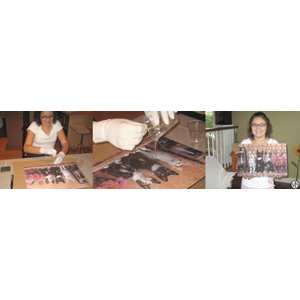
According to Eric Chaimberg of Swing Paints, the country's leading manufacturer of wood finishing products, the most protective finish they offer is their two-part epoxy. "This is a great way to create works of art with your kids' projects, your tabletops, bar top or desks. The two-part epoxy has the capability to embed puzzles, photographs, coins, newsprint or anything else you can come up with in its finish" he added. "There is really no limit to what you can create."

For example, one coat of high-gloss Circa 1850 Nu-Lustre-55 finish is about 1/16-inch thick - the equivalent of 55 coats of varnish. It's simply poured over a chosen surface and self-levels to a smooth finish in just a few minutes. It may be applied over almost any surface or item, rough or smooth. Leather, wood, varnish, ceramics, rocks, dried flowers, shells are just some of the items you can cover. It cures to a thick, high gloss coat in about twenty-four hours, and it stays crystal clear. One coat is usually all that is needed to produce the desired finish.

How to use the finish to preserve images/photos on a surface:

After the item has been mounted to the surface, seal the entire image with a solution of four parts white glue and one part water. This will prevent the item from becoming translucent. Wait three to four hours to fully dry. Then just pour out the Circa 1850 Nu-Lustre-55 mixture and let it set - it's just that easy!

Craft ideas:

Circa 1850 Nu-Lustre-55 can make any of your kid's craft projects come to life.

· They can protect their favorite puzzle or popsicle-stick collage with its high-gloss crystal clear finish.

· They can use it to simulate water and create that floral design for Mother's Day that will last a lifetime.

· Use it to embed sports or trading cards, magazine covers, newspaper clippings or photos onto their desk,tabletop or cover of a photo album.

Decorative applications:

Create a customized piece of furniture by embedding your favorite sports photos or memorabilia directly onto your bar top or table-tops. Let your imagination run wild with a mixture of items that will really show off your personality.

Or, for the more adventurous types, try adding universal tinting colours to your Circa 1850 Nu-Lustre-55 mixture. This coloured finish is now ready to create the most lively of projects from your kid's play table to coloured tiles to decorate the walls. And if you mix up multiple colours, Circa 1850 Nu-Lustre-55 is the perfect product to give an old bathroom counter a faux marble finish. Cover the surface with one colour and then drizzle other colours on top using a popsicle stick to create swirls.

For more information or ideas on finishing visit www.circa1850.com.

Tags:
, , , , , ,


Create Craft


Share on: facebook

Sunday, August 06, 2006

Planning and Organizing a Successful Baby Shower

Besides the birth of a baby, a baby shower is a joyous special event that takes place in the life of a mother-to-be. Baby showers evoke images of women happily fussing over a pregnant mother and presenting special gifts to the unborn baby. If you are planning to hold a baby shower for someone you know or you have been invited to attend a baby shower, here are some tips to keep you on the right track, as well as some ideas to make the baby shower more memorable.

Baby showers are popular with mothers-to-be in many countries. So it is important to remember to pay special attention to any social customs or practices in your country to avoid a social faux pas.

Traditionally held by a close friend of the new mother, baby showers are now also helped by relatives, neighbors or colleagues from work. The baby shower is normally held at the home of the host, and she would be the one to shoulder the expenses for the food and other items.

Normally a baby shower would take place a month or two before the birth of the baby. Formal invitations are not required; however they lend a nice touch to a baby shower. Invitations need not be expensive. They could be handmade with store-bought stationery. Choose pastel colored invitations, write a little message and directions to the venue, and send them to the guests three weeks in advance.

A baby shower should be held during the weekends, as it would be most convenient for guests to attend. It could last two to three hours or even longer if everything is going well with the guests.

During a baby shower, guests would bring gifts for the baby. The most appropriate gifts are of course baby items such as baby clothing, booties, diapers, feeding bottles, bibs and baby blankets. Present gifts in neutral colors so that the gifts will be suitable for either a boy or a girl. These are everyday items that would be very useful. Having the baby shower before the birth of the baby will give ample time for the mother to buy the items that were not given as gifts during the baby shower.

The number of people to be invited of course depends largely on the venue. Sometimes a small number is invited before the birth while a larger group is accommodated after the birth of the baby. And remember there is nothing wrong in having a baby shower to celebrate subsequent babies. Baby showers are not only for the first-borns, as every pregnancy is a reason to celebrate.

The host should pay special attention to food and drink as well as conversation to ensure that everyone has a good time. The host could have games to break the ice, but this is of course not necessary.

Having a theme too would add more life to the baby shower. The theme could be incorporated into the invitations, the food and drinks as well as the decorations. Again, decorations need not be expensive, just use your imagination.

The host should always be present during the party and should be the one attending to the guests. She should be there to welcome guests when they arrive and thank them when they leave.

It would be nice if the host could provide a book for guests to write messages to the mother to be. Another alternative is to have little cards for guests to write the well wishes to the expecting mother. The cards could then be inserted into a special photo album together with photographs taken on that day as a special memento for the mother.

Having a baby shower is a wonderful experience not only for the mother-to-be, but also for the host as well as the guests. A baby shower is a fantastic opportunity for everyone to share in the joy of the arrival of a new baby.


Technorati Tags:
, , ,


Baby Shower

Share on: facebook